Trust Finance
ETH Global Superfluid Best Overall Prize, Polygon Hackathon Runner Up Prize
Role: Co-Founder, Product Manager, UX/ UI Designer
Trust Finance
Enabling Simple and Real Time Payments, HR Benefits, and Accounting for Crypto Businesses and Personal Users.
Problem Space
Businesses and employees face lots of friction when trying to make payroll payments, invest, or track transactions using crypto.

Businesses
- Paying salaries in crypto can be time consuming. DAO and crypto startups founders have to make individual payments to team members from their own wallet in a process that can take hours.
- There's no cohesive audit trail if you're a crypto company. Crypto transactions can span a dozen different wallets or products.

Employees
- Moving income to investment accounts takes between 4 - 7 days for funds to be available for investment.
- It is impossible for employees to manage and configure their investment asset (savings, investment or retirement accounts - 401k or IRA) in real time.
What will it take for DAO, NFT, and DeFi businesses to scale and onboard the next 1 billion users?
Our Solution
Trust Finance provides simple and real time payroll payment, benefits, and transaction tracking for businesses and employees (freelancers); thereby helping businesses attract the best talents, customers, and business partners.
We believe improving the human interaction layer (UX and coordination) through providing BETTER PAYMENT, HR BENEFITS, and ACCOUNTING could help businesses scale.
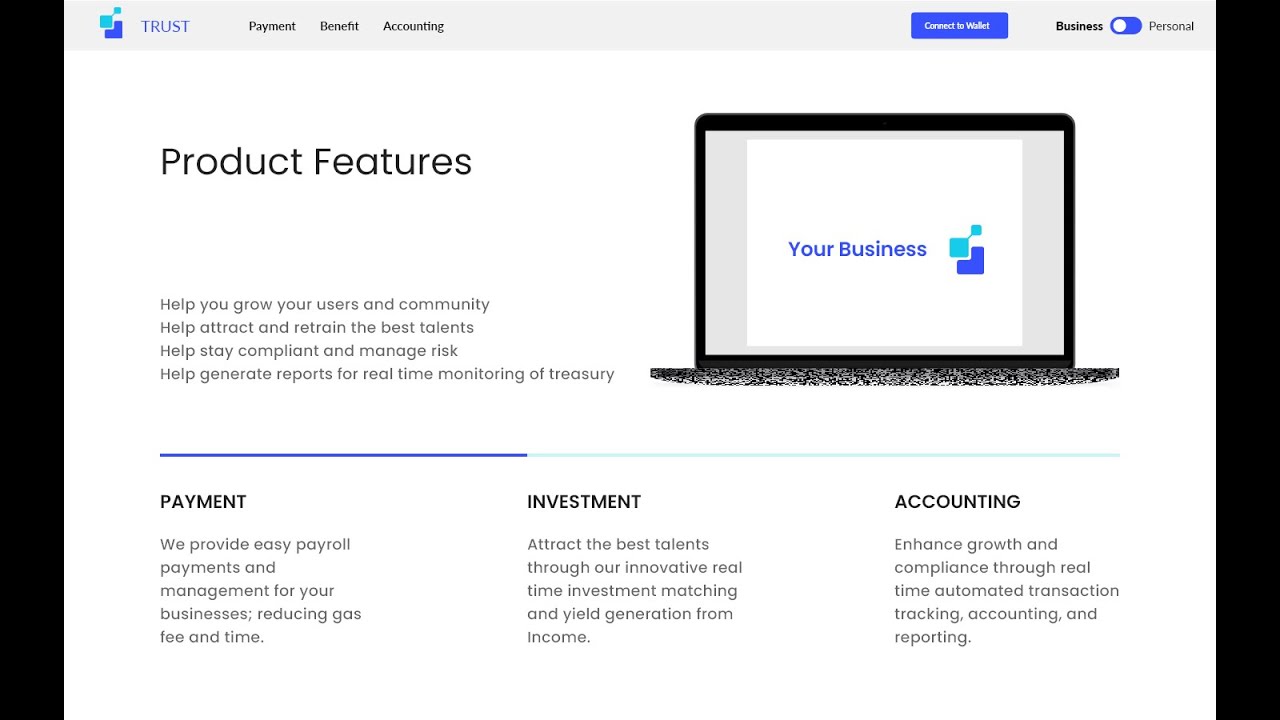
PAYMENT

We provide easy payroll payments and management for your businesses; reducing gas fee and time.
BENEFITS

Attract the best talents through our innovative real time investment matching and yield generation from Income.
ACCOUNTING

Enhance growth and compliance through real time automated transaction tracking, accounting, and reporting.
01. Research
I. Why Now
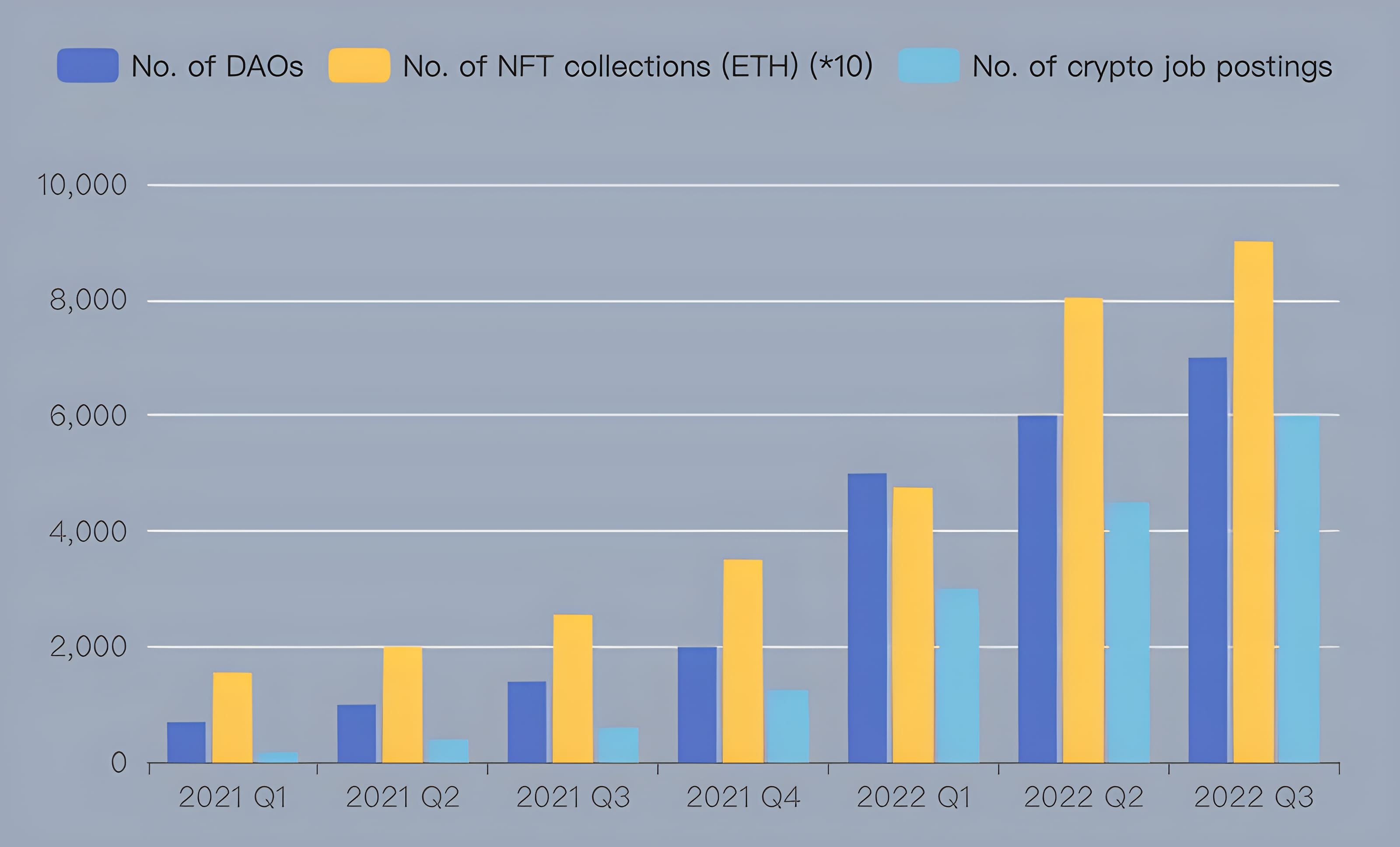
· Rapid growth in the number of DAOs
- 8.8x in # of DAOs
- 8.5x in # of proposals
- 8.3x in # of votes
- Total Treasury: ~$8.8B in 2022
· Rapid growth in the number of NFT collections
- Daily volume increased 90x from $622M in 2021 to $54.6B in 2022
- Daily active address increased by 65% to 550k
· Growth in talents need in Web3
- Crypto job postings globally went up by 400% in 2021
- 1.1 billion freelancers, 31% of total workforce in 2022, with avg. $39K yearly income, represent approx $42.9 trillion market
II. Market Drivers and Trend
Freelancer Economy
- 57.3M people in the US are freelancers
- Freelancers in the US contribute $1.4 Trillion to the economy every year
- 51% of the US workforce will be freelancers by 2027
Crypto Payments Boom
Currently 2300 business accepting crypto
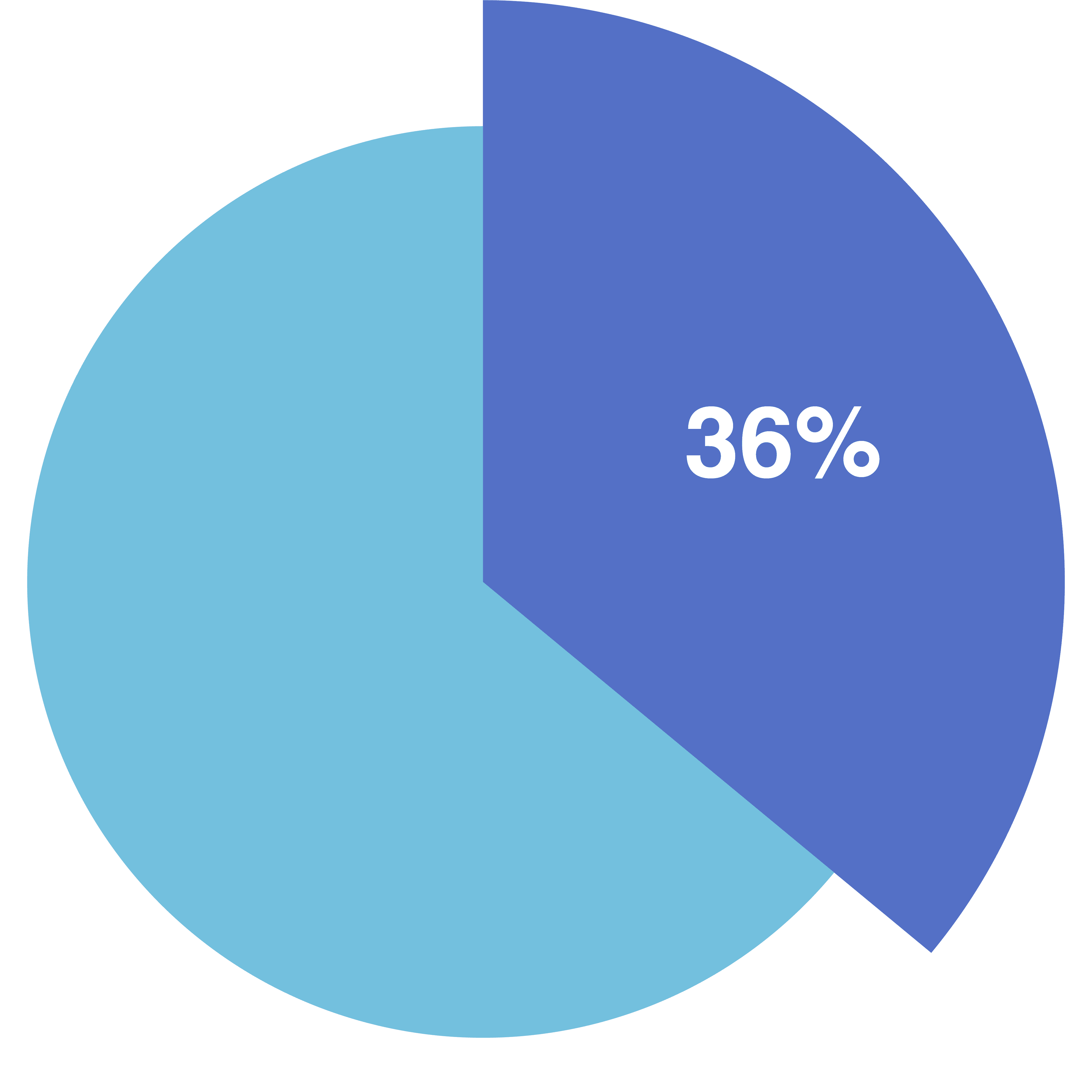
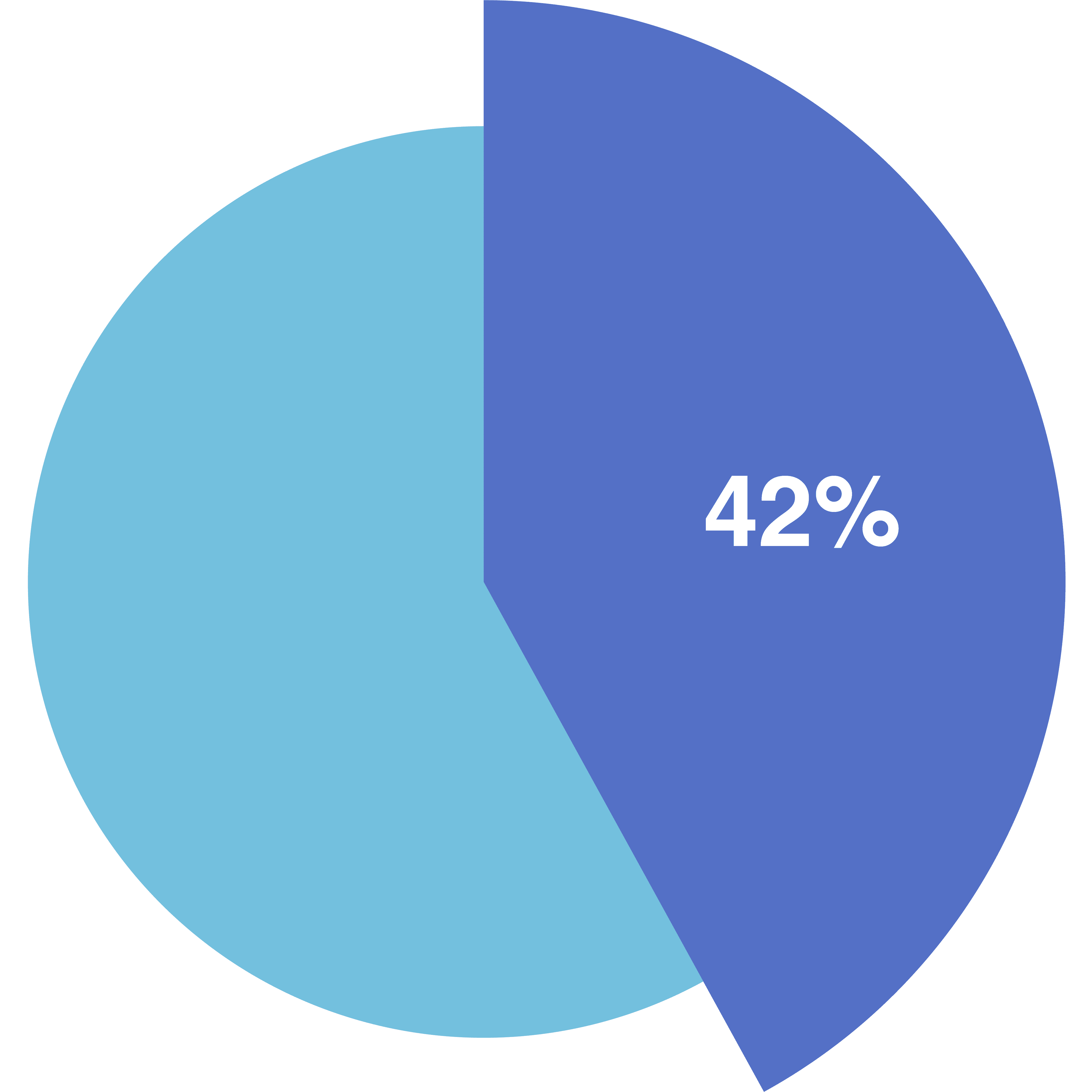
Research conducted by SoFi shows 36% of workers want the ability to receive part or all of their paycheck in cryptocurrency, and 42% would like to receive NFTs as a performance reward.
Millennials and freelancer talents are the greatest drivers of payroll crypto payment.
III. Personas
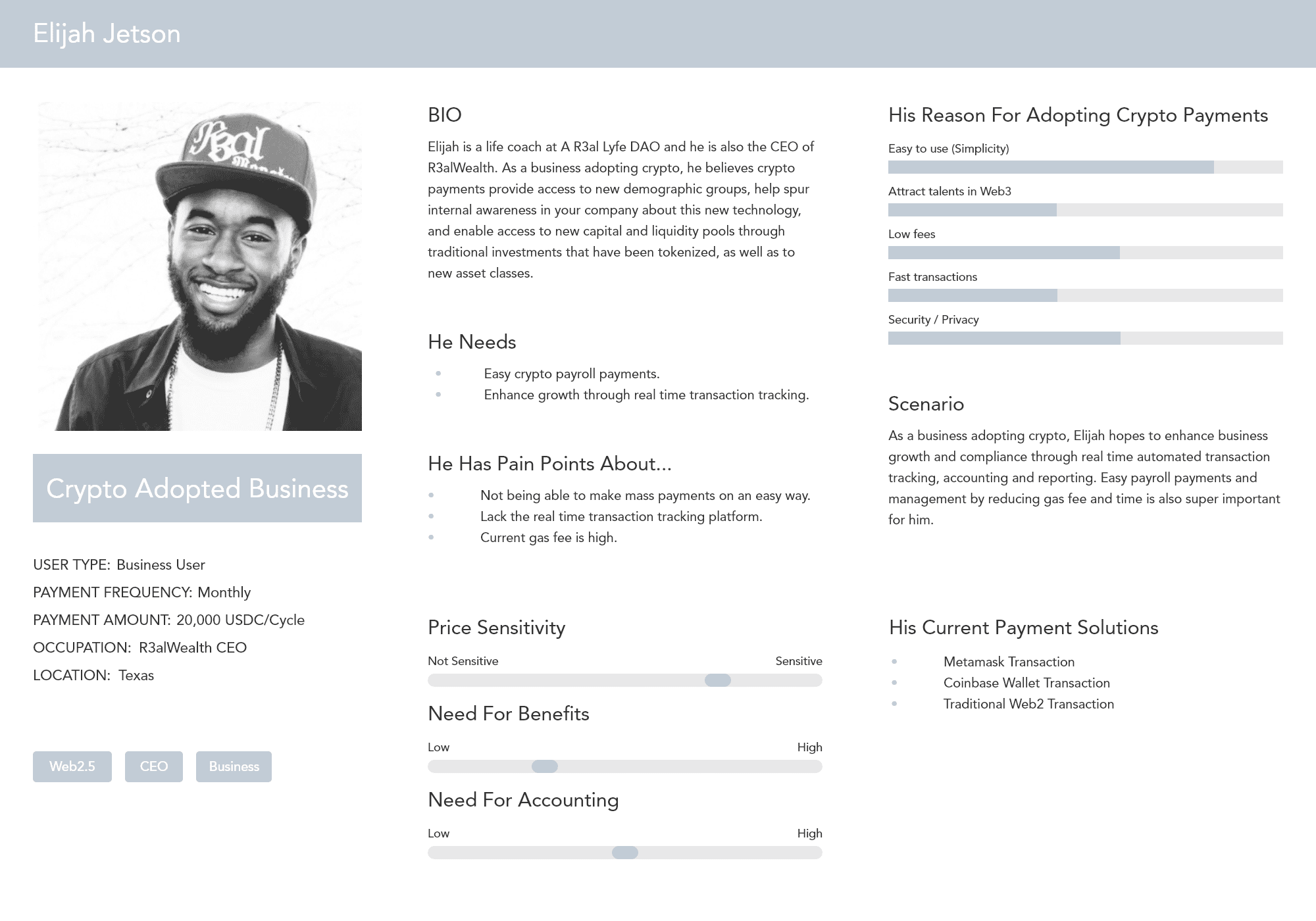
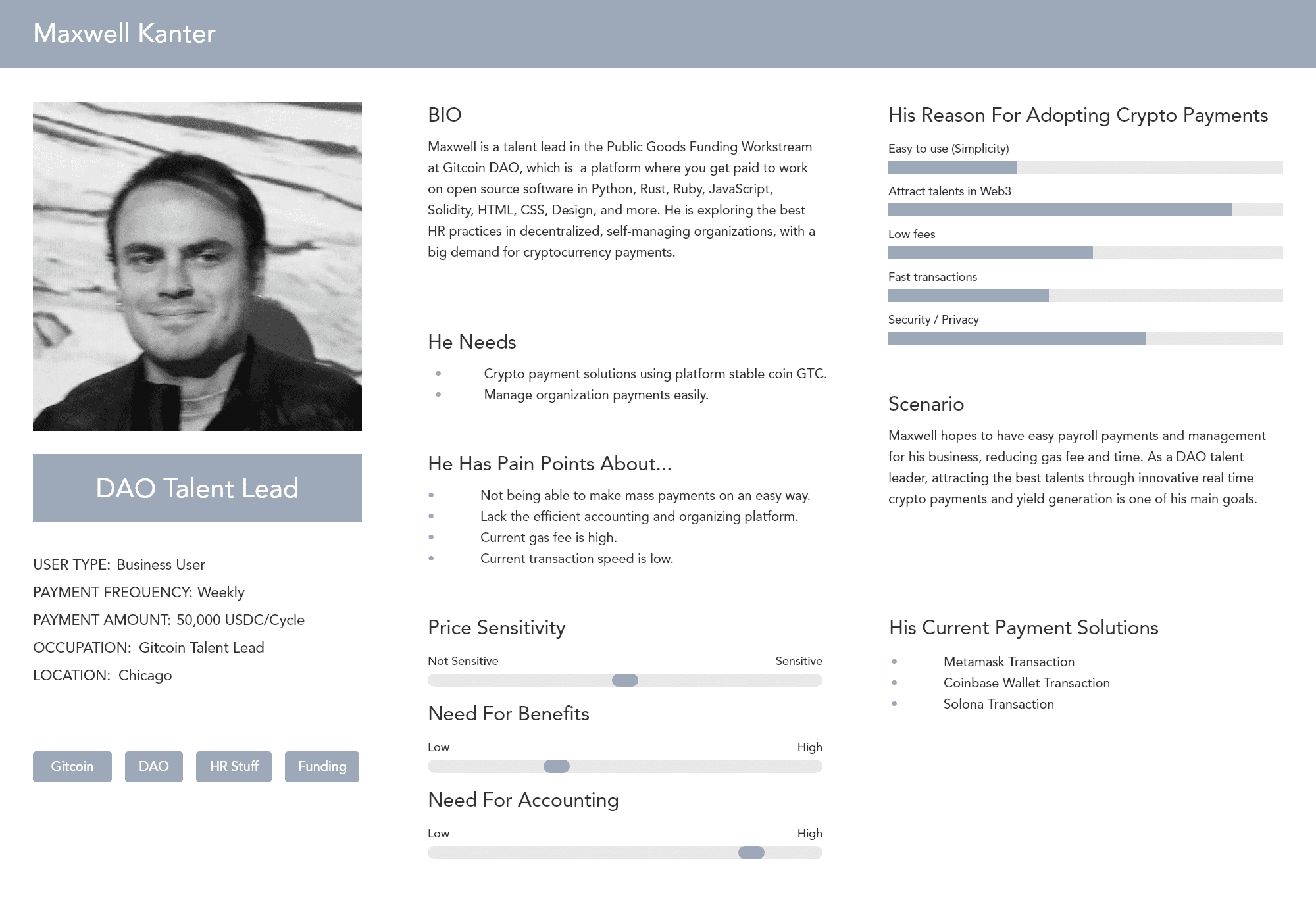
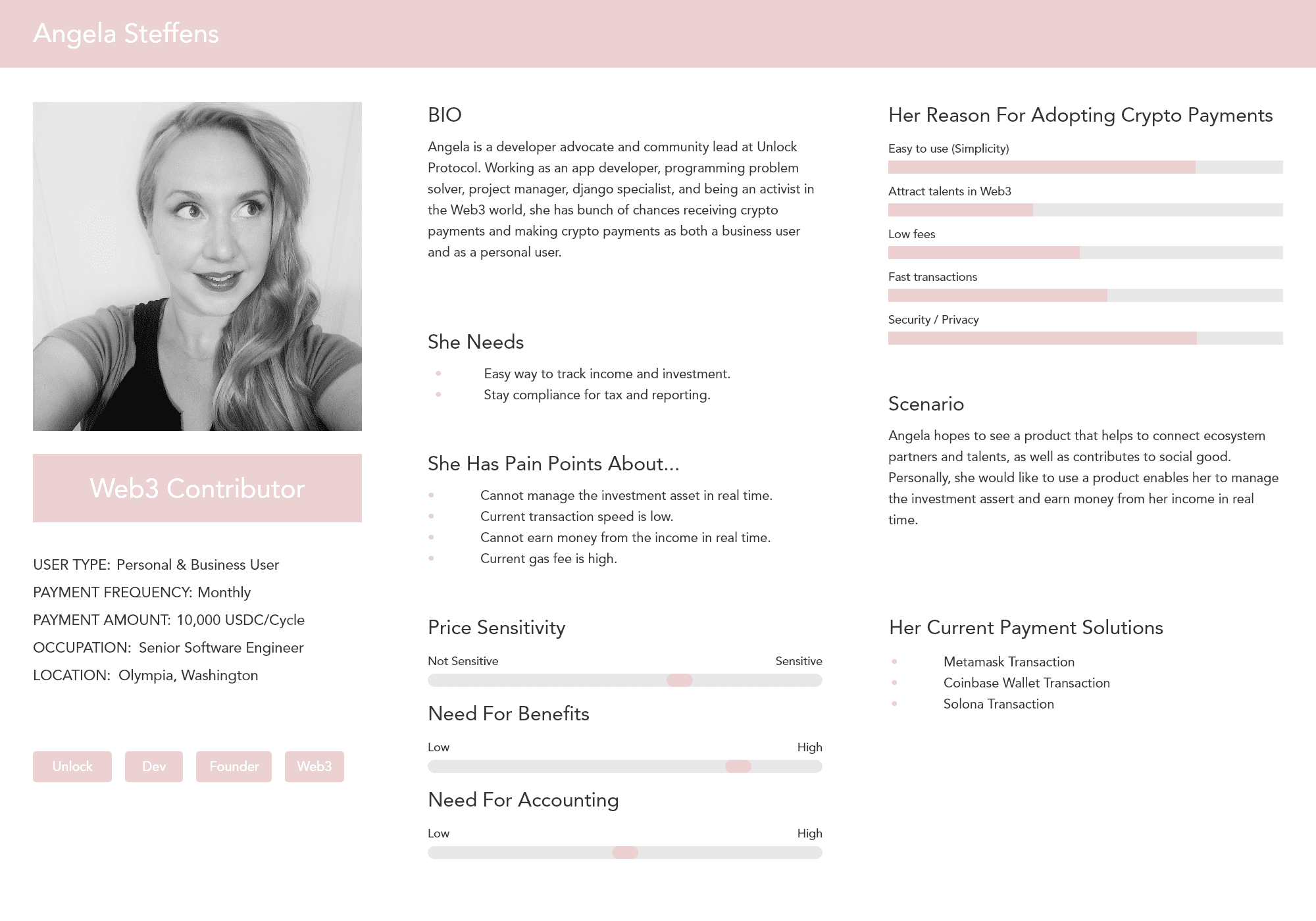
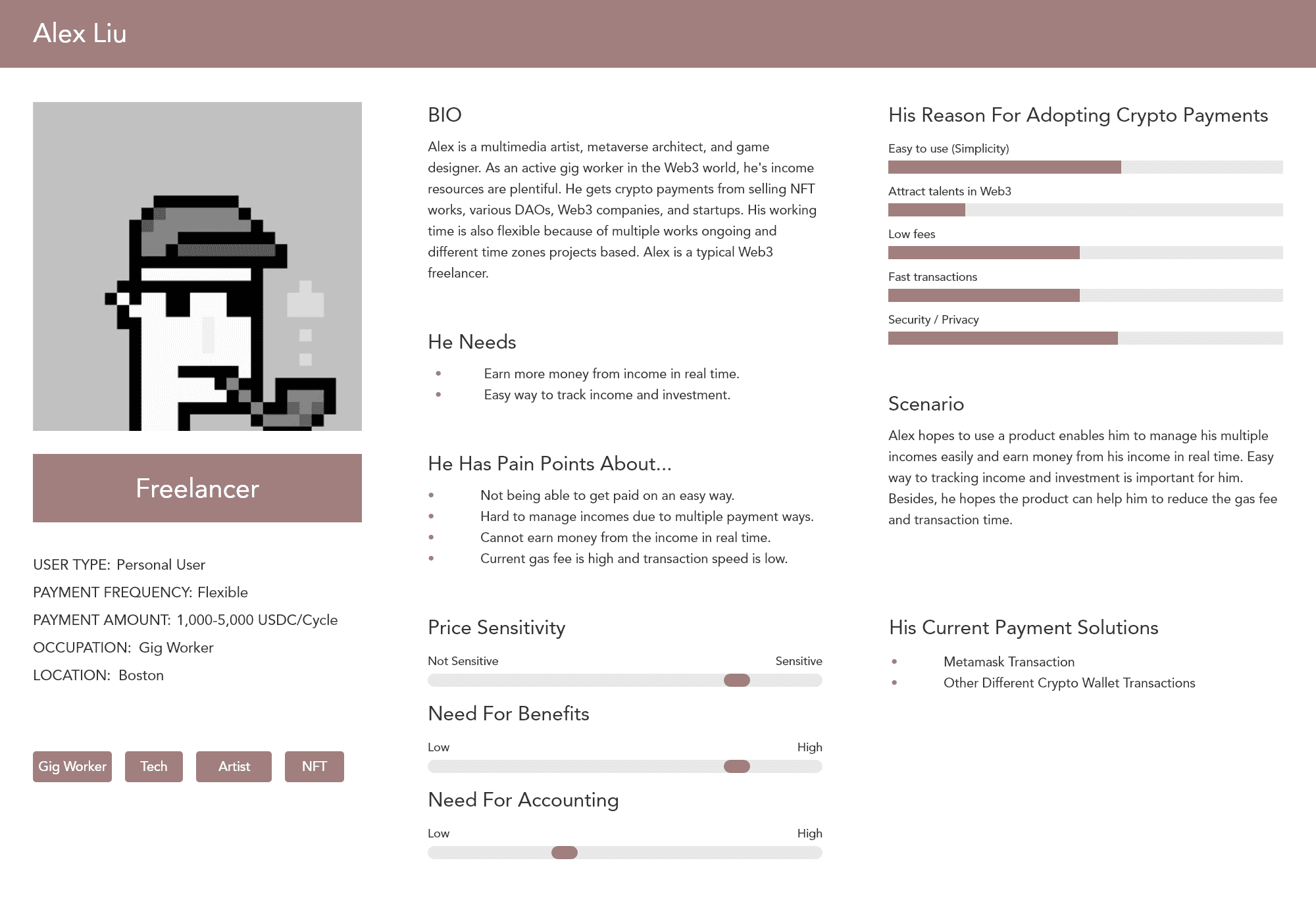
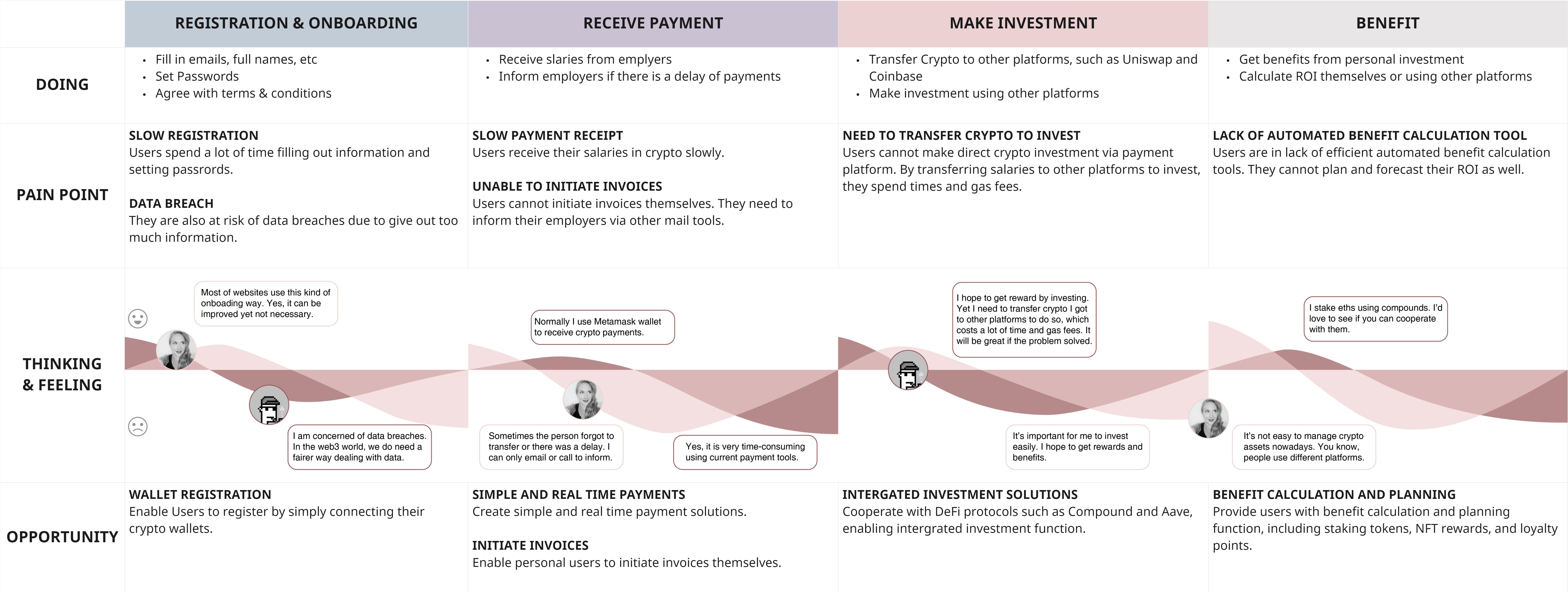
I created behavioural personas and an user experience map to provide a digestible means of understanding information. These design tools created a shared understanding of customer needs, frustrations and opportunity areas and were used to inform design decisions.
Business Users
Personal Users
IV. Experience Map
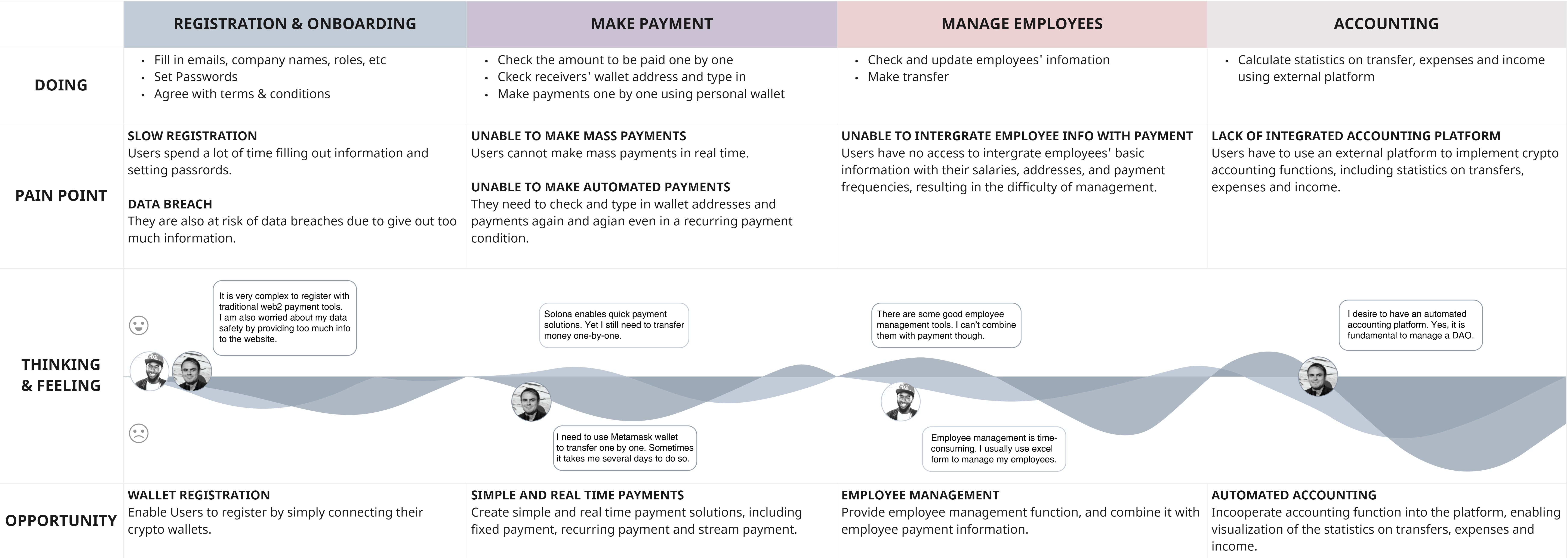
I developed user experience maps to better visualize the pain points experienced by these personas. The team decided to focus specifically on the payment and employees/funds management aspects of the journey; as we identified several pain points and opportunities in this space, most notably as below:
Business Users
- Slow registration & data breach
- Unable to make mass payments or automated payments
- Lack of integrated accounting platform
Personal Users
- Slow registration & data breach
- Slow payment receipt
- Unable to initiate invoices
- Need to transfer crypto to make investment
- Lack of automated benefit calculation tool
02. Requirements Gathering
I. UX Requirements
Our team then was engaged to bring the crypto payment solutions for both business users and personal users to life. To start, I translated the future state journey map into a screen flow.
Business Users · Login · Authorize Payment · Manage Payment

Personal Users · Login · Investment · Benefits · Rewards

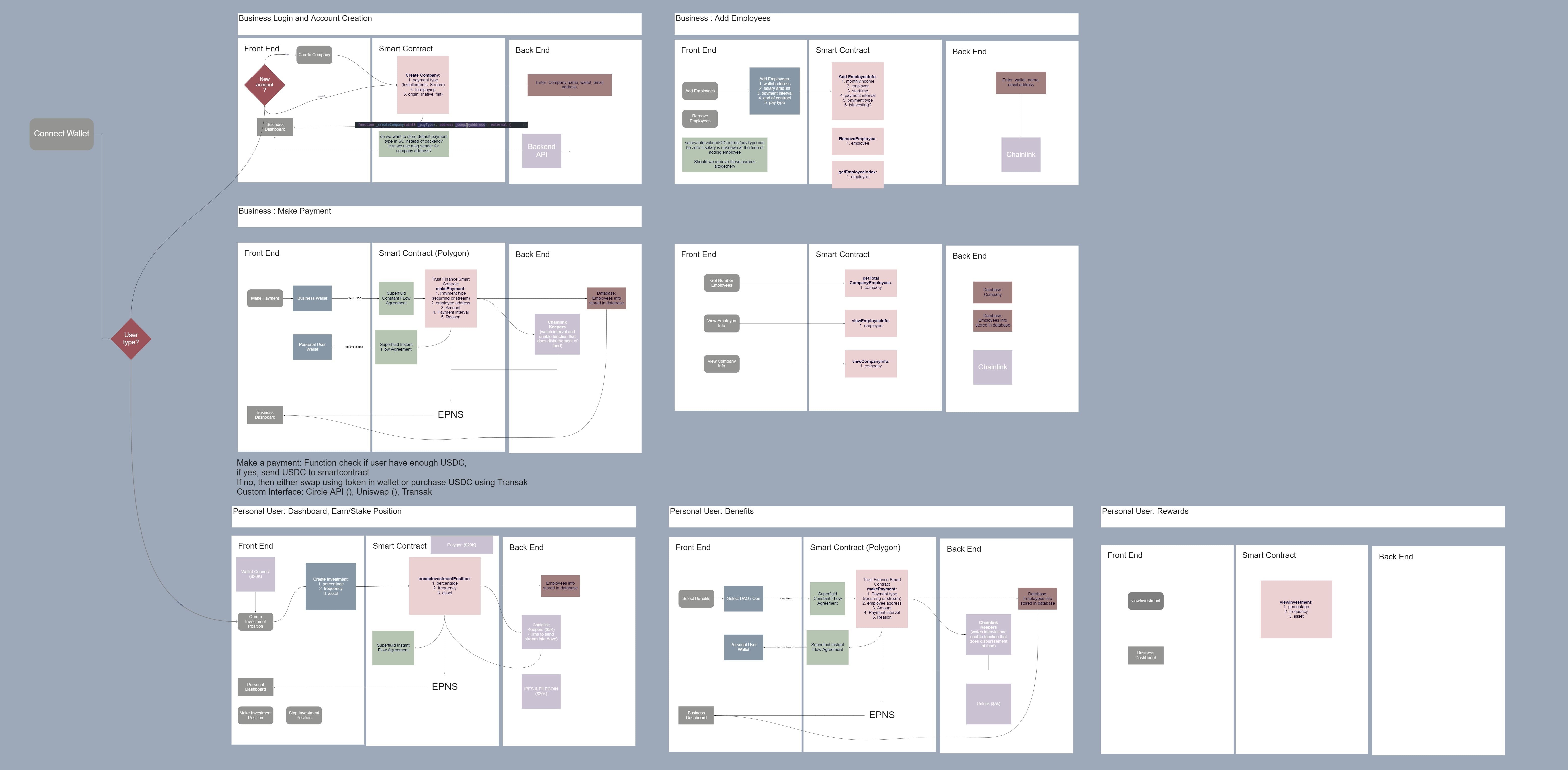
II. Functional & Technical Requirements
We worked closely alongside all stakeholders to ensure we were aligned and that any impacts to UX based on the functional/technical requirements, or vice versa, were communicated clearly. Outputs included:
- Front End (WalletConnect, Coinbase Wallet, Transak)
- API (Superfluid, Chainlink, Aave, Uniswap)
- Smart Contract (Polygon L2 Blockchain)
03. Prototyping
I. Design Principles
Before diving into prototyping, we developed design principles based on the needs, pain points and goals of customers - uncovered during the Strategy Phase - as well as inspiration from industry leaders and UX best practices. These principles provided the basis for design decisions to ensure an intuitive, frictionless and flexible experience for users.
Principle 1: Meet the users' need
Center on improving users' experience, and meeting their needs that we learned from user research with the product.
Principle 2: Clear hierarchy
Ensures smooth navigation throughout the application with clear information and visual hierarchy.
Principle 3: Keep it consistent
Familiar the design to users by sharing some similarities with other payment products they regularly use.
Principle 4: Less is more
Reduce clutter and keep things simple to focus user's attention and decrease cognitive load.
II. Prototypes
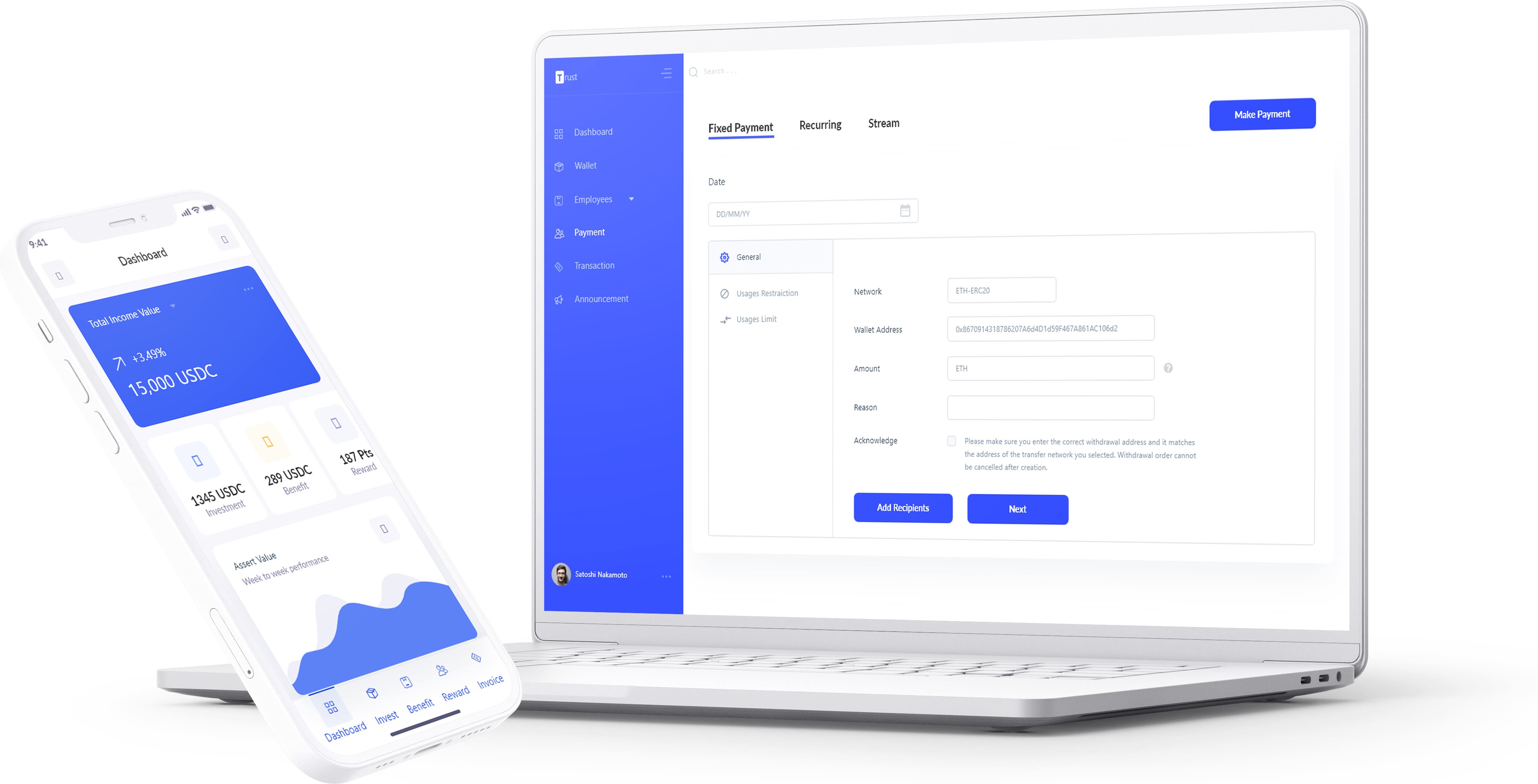
I created interactive desktop prototype for business users and mobile prototype for personal users, to capture the end-to-end flow of the crypto payment solutions, including conditional logic applied to certain screens and questions. This helped stakeholders better understand what the customer journey could look like and was used to drive design review sessions, test concepts, and gather feedback for continuous iteration.
III. Wireflows
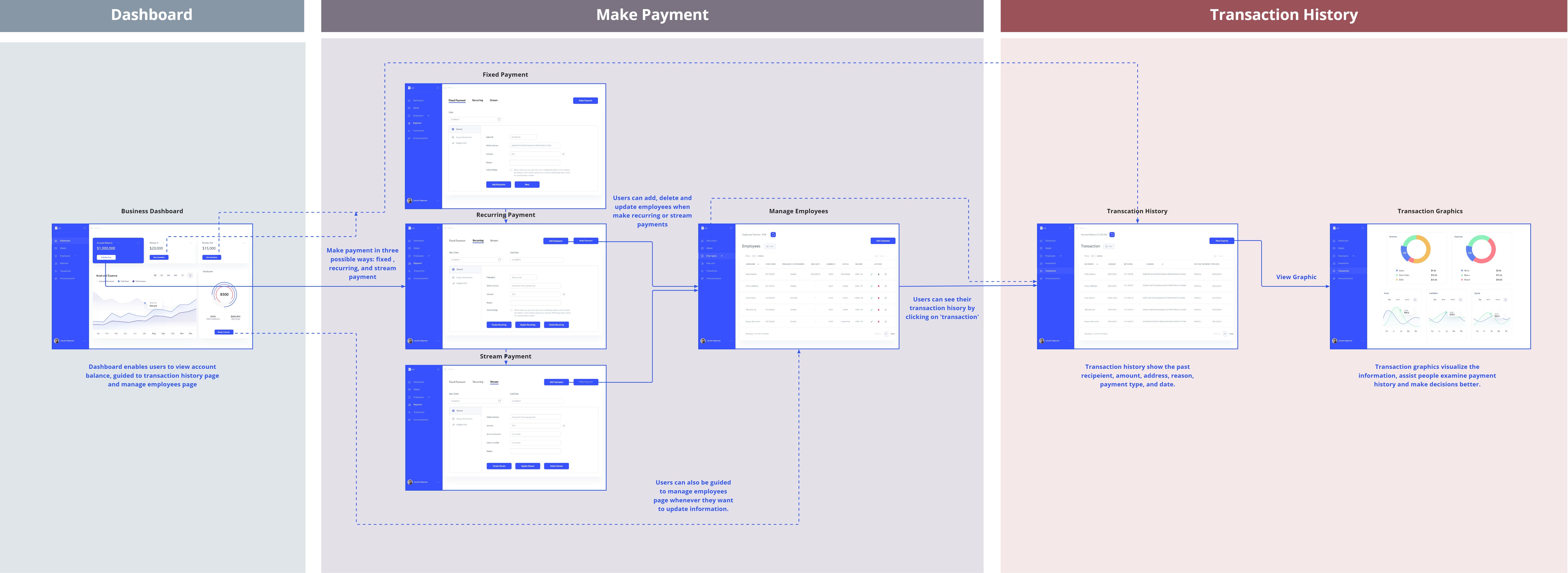
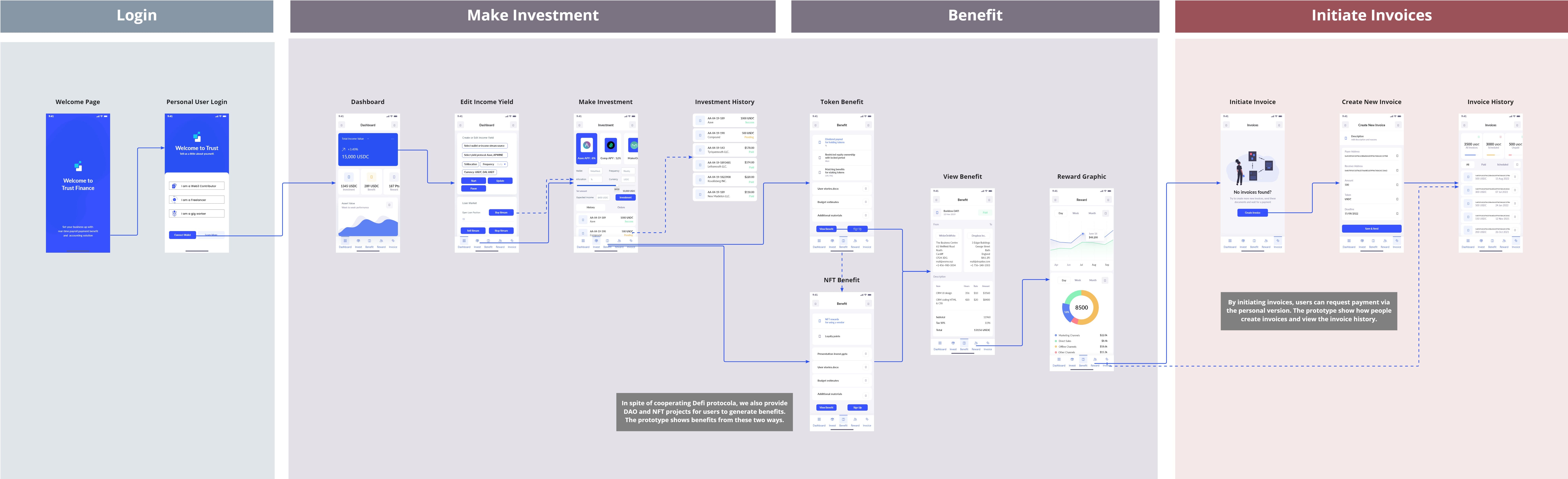
I created several wireflows to illustrate the entry points into the desktop application as well as placement points for the crypto payment solutions, including making paying and managing employees for businesses, and making investing and invoicing for personal users.
Desktop Onboarding Prototype Wireflow | Scenario: New users access to the application, learn about product features, and subscribe
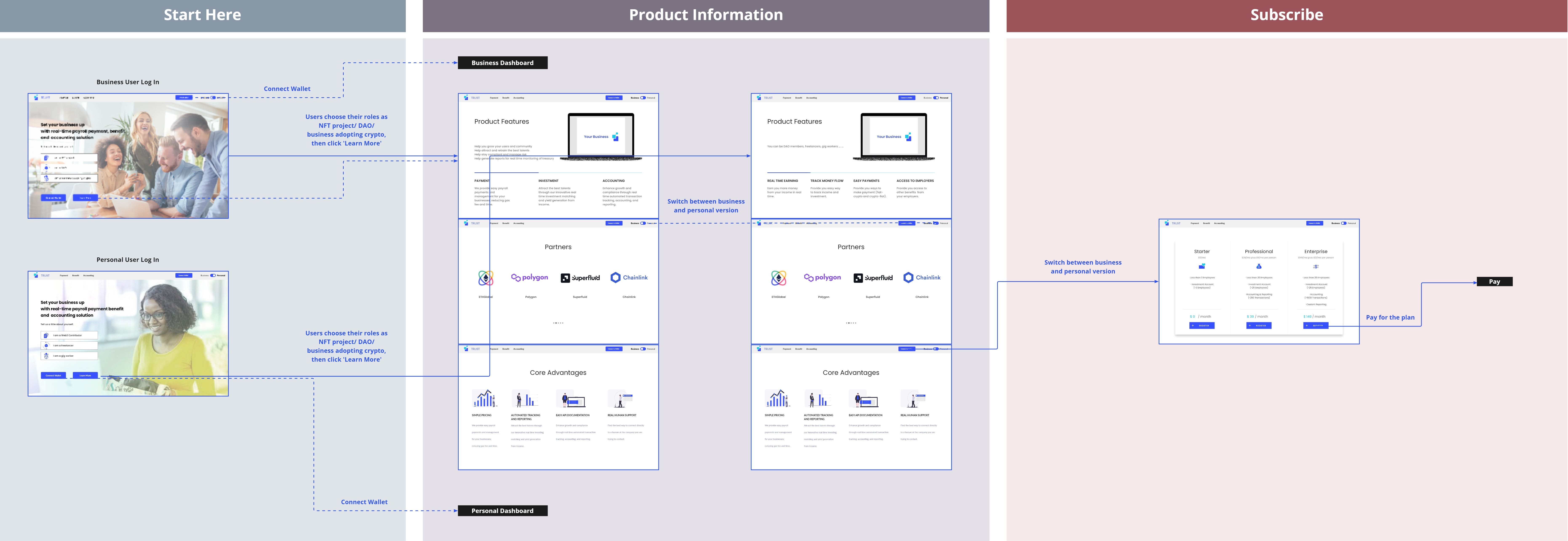
Business users make payments and manage employees
Personal users make investment and initiate invoices
04. Detailed Design
Once the wireframes were completed, I worked closely with our frontend engineers and product team to create high-fidelity detailed designs for mobile and desktop. These visual designs incorporated our design principles.
We held several design review sessions with the user community to gather feedback and iterate on the wireframes and detailed visual designs to ensure that they addressed user needs and also captured information required by the businesses and personal users.
I. Feature Highlights
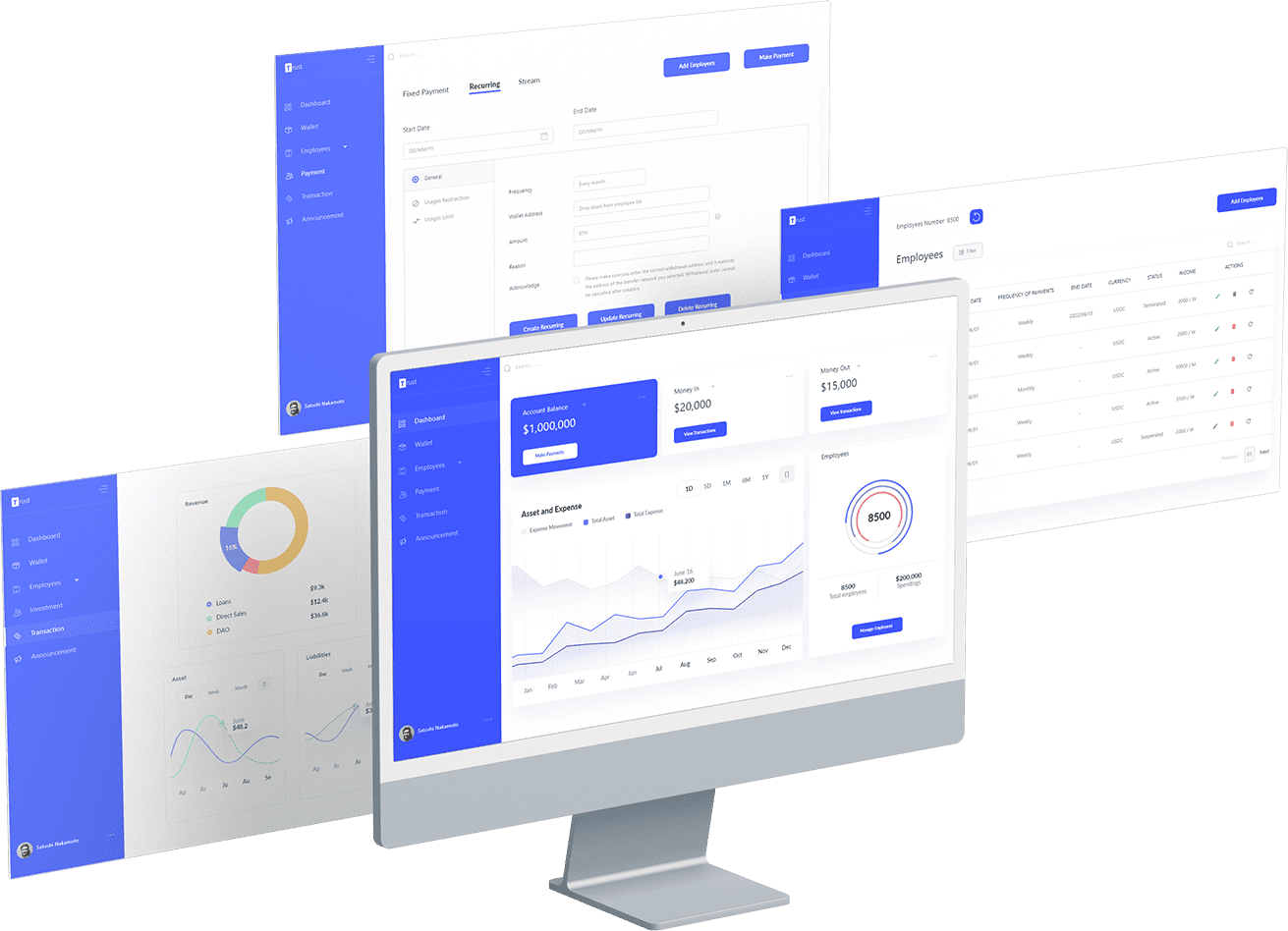
Business Version
Make Payment - We provide three types of payment methods to business users - fixed payment, recurring payment, and stream payment.
Manage Employees - In the process of making recurring payment or stream payment, user can add, edit or delete employees at any time.
Accounting - Allowing customers to view and manage their crypto income, expenses, and percentage clearly.
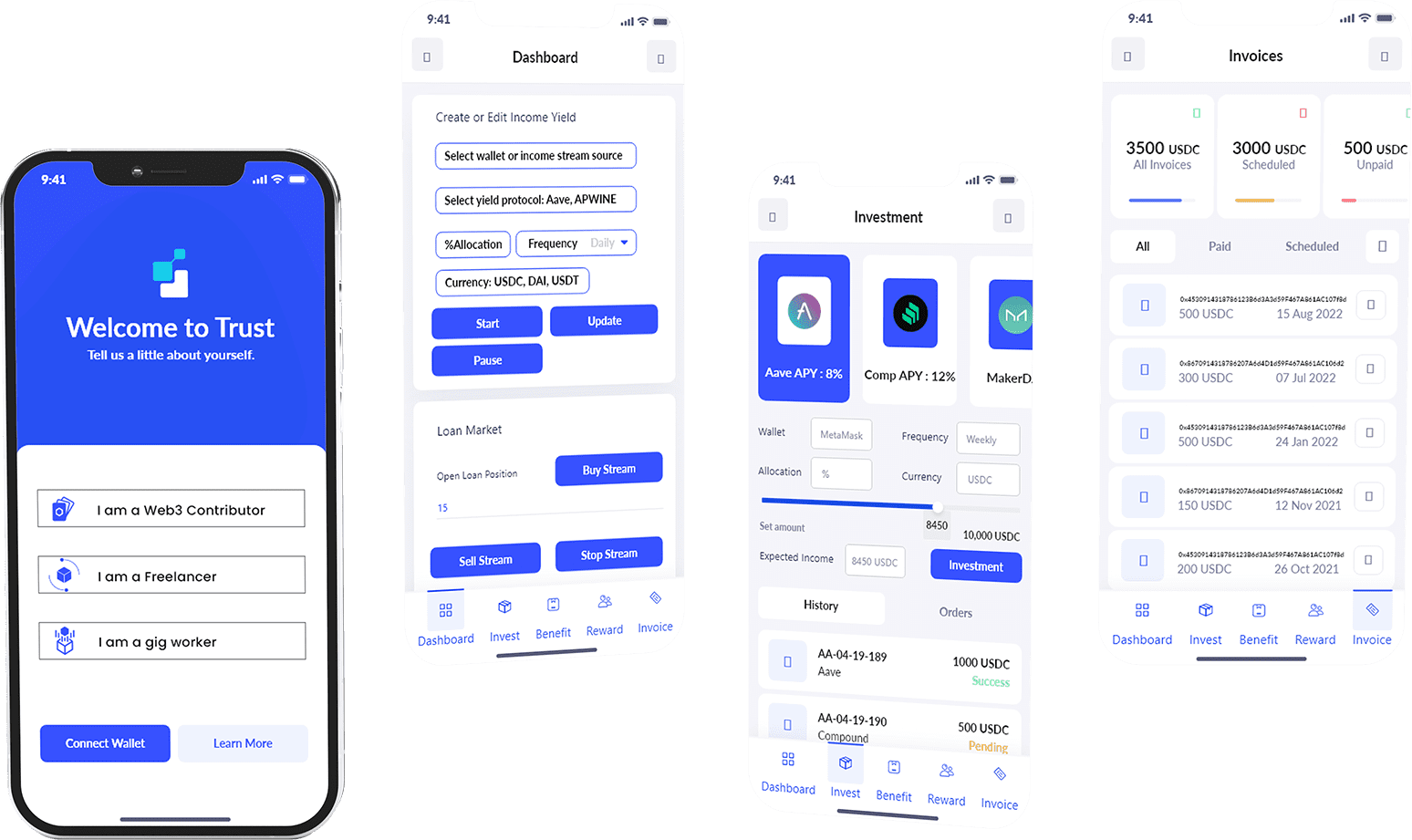
Personal Version
Make Investment - By cooperating with various DeFi protocols such as Compound and Aave, the product ensures the user can make payment directly via the investment panel.
Initiate Invoices - Personal users can initiate invoices themselves to their employers, enabling an efficient payment communication.
II. Demo Videos
Business Version developed during ETH Global HackMoney
Personal Version developed during ETH NYC Hackathon

05. Product Development
I. Customer Acquisition
We focus on DeFi, NFT, and DAO projects looking to scale and attract talents to contribute in their ecosystem. Customer acquisition comes from two sources:
Partnerships & Referral Program
- Ecosystem Partnerships: Polygon, SuperFluid, Chainlink
- Supporting NFT and DAO projects: PrimeDAO, MakerDAO
- Participation in hackathons and Crypto events: ETH Global, Permissionless, Consensus
- Business and Personal user referral program
Online & Offline Channels
- Email Marketing
- Online campaigns on LinkedIn, Google Adwords, Instagram
- Brand advertising and content marketing
- Events (Webinars, AMAs)
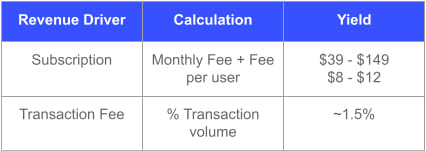
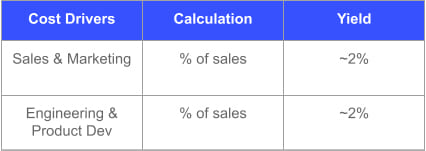
II. Revenue Model
III. Product Roadmap

06. Impact & Reflections
I. Impact
Trust Finance provides simple and real time payroll payment, benefits, and transaction tracking for businesses and employees (freelancers); thereby helping businesses attract the best talents, customers, and business partners.
By improving the human interaction layer (UX and coordination) through providing better payment, benefit, and accounting, the application could help businesses scale and onboard the next 1 billion web3 residents.
II. Reflections
This was one of the personally most impactful projects for me for two main reasons:
First, this is the first project where I've been involved as both a designer and a CoFounder at the same time. I not only participated in product design, UX design and UI design of the application, but also looked at its user acquisition, market potential, and roadmap from a startup founder's point of view. I've talked to over twenty VCs about the product, and worked with the team to define and redefine its capabilities in countless internal meetings and user interviews, which gives me a valuable ability to think globally and to decipher the details.
Second, finance used to be an area I wasn't very familiar with. However, the best cross-functional team taught each other skills from our respective areas of expertise. We each brought different skills to the table: UX/UI design (myself), finance and product (Quadri), smart contract (Chilo and Phidel), frontend engineering (Prateek). This experience affirmed my belief that teams produce the best work when they exchange skills and perspectives and immerse themselves in each other's work, rather than working in silos.